

- Common name - Red mullet, Striped red mullet
- Scientific name - Mullus surmuletus
- Visit Fishonline for the full range of options available for this species.
- Consumer Information
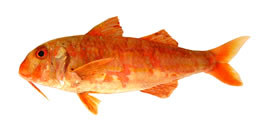
- Distributed throughout the world in tropical and warm temperate seas, it is one of two species found in the Mediterranean (the other being Mullus barbatus). Also found as far north as Britain and Ireland in summer. A small fish, belonging to the Mullidae or Goatfishes family. It is a relatively fast growing species, maturing at 2 years old. Red mullet has a hoover-like mouth and distinctive barbels - sensory organs - with which it detects food and sifts it from the sea bed. The barbels are the reason for its alternative name - goat fish. It is not related to the grey mullet. In general, red mullet are a reddish pink with yellow stripes. The vibrant red colour fades as soon as they die. Its high fat content adds a richness to it's flavour. It's liver is considered a delicacy and the fish is often sold and cooked ungutted (though its advisable to remove the green gall bladder which can impart a bitter flavour). Good grilled, but can be shallow fried or baked. Taken as by-catch and in mixed trawl fisheries in Britain. Avoid eating immature fish (less than 22cm) and fresh (not previously frozen) fish caught during the summer spawning season (May-July). Avoid eating abroad as it is subject to high fishing pressure in Mediterranean fisheries.
- Summary
- Red mullet stocks are currently stable or increasing. There is no specific management for the species however current rates of fishing do not appear to be damaging the stock. Choose red mullet caught by gill or seine net where possible as these methods have a lower environmental impact. Avoid eating immature fish (less than 16 cm) and fresh (not previously frozen) fish caught during the summer spawning season (May-July).
- Alternatives
- (Based on method of production, fish type, and consumer rating: only fish rated 3 and below are included.)
- Visit Fishonline, the website for the seafood industry, for more detailed information about this species.


 A message from our sponsor: You can support marine conservation efforts in Britain by playing the People's Postcode Lottery. We support our charity partners' commitment to protect the marine environment, highlight the fragile nature of our oceans and campaign for better fishing practices. www.postcodelottery.com
Marine Conservation Society
Company Limited by Guarantee No. 2550966
Registered Charity England and Wales No. 1004005 |
Scotland No. SC037480
Registered Office: Unit 3, Wolf Business Park, Alton Road,
Ross on Wye HR9 5NB, Scottish office: 3 Coates Place,
Edinburgh EH3 7AA. Copyright MCS 2012 All rights reserved.
Company Limited by Guarantee No. 2550966
Registered Charity England and Wales No. 1004005 |
Scotland No. SC037480
Registered Office: Unit 3, Wolf Business Park, Alton Road,
Ross on Wye HR9 5NB, Scottish office: 3 Coates Place,
Edinburgh EH3 7AA. Copyright MCS 2012 All rights reserved.