

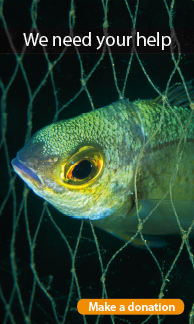

- Common name - Gurnard, Grey
- Scientific name - Eutrigla gurnardus
- Visit Fishonline for the full range of options available for this species.
- Consumer Information
- Gurnards belong to a family of fish known as ‘sea robins'. Unlike robins, however, they are not the prettiest of creatures! There are three common varieties of gurnard red, grey and yellow or tub. Red gurnard is the species most commonly exploited as a food fish. It lives on the seabed and stirs up food with its ‘legs' narrow spiny fins adapted for the purpose. They are quite bony fish and one needs to buy them with their fins and skin removed. It's not got a strong flavour and so is often used in soups or stock or stuffed. Taken as by-catch in trawl fisheries, red gurnard is a fast growing fish which matures early at a large size. Avoid eating immature fish (less than 20cm) and fresh (not previously frozen) fish caught during the spawning season (summer). Grey gurnard are taken as by-catch in trawl fisheries in deeper offshore waters. Avoid eating immature fish (less than 24cm) and fresh (not previously frozen) fish caught during the spawning season (April-August). The largest European gurnard, Tub or Yellow gurnard, appears to be more vulnerable to fishing than either red or grey. Avoid eating immature fish and during their breeding season (May to July).
- Summary
- Grey gurnard is a fast growing fish and matures early at a large size. Avoid eating immature fish (less than 24cm) and fresh (not previously frozen) fish caught during the spawning season (April-August). Gurnards are non-quota species, so they are often discarded due to low market demand. Increased consumption and demand for the species will alleviate the need to waste fish through the practice of discarding, but efforts must be made to understand the biology of the stocks and manage them appropriately, if the species is to become commercially targeted.
- Alternatives
- (Based on method of production, fish type, and consumer rating: only fish rated 3 and below are included.)
- Visit Fishonline, the website for the seafood industry, for more detailed information about this species.


 A message from our sponsor: You can support marine conservation efforts in Britain by playing the People's Postcode Lottery. We support our charity partners' commitment to protect the marine environment, highlight the fragile nature of our oceans and campaign for better fishing practices. www.postcodelottery.com
Marine Conservation Society
Company Limited by Guarantee No. 2550966
Registered Charity England and Wales No. 1004005 |
Scotland No. SC037480
Registered Office: Unit 3, Wolf Business Park, Alton Road,
Ross on Wye HR9 5NB, Scottish office: 3 Coates Place,
Edinburgh EH3 7AA. Copyright MCS 2012 All rights reserved.
Company Limited by Guarantee No. 2550966
Registered Charity England and Wales No. 1004005 |
Scotland No. SC037480
Registered Office: Unit 3, Wolf Business Park, Alton Road,
Ross on Wye HR9 5NB, Scottish office: 3 Coates Place,
Edinburgh EH3 7AA. Copyright MCS 2012 All rights reserved.