
Top tips
Sustainability is becoming hugely important for consumers who are looking to purchase seafood with a clear conscience - but why should you care? Actually, you have power to make a real difference. As a consumer, you can drive the market for sustainable seafood, by choosing fish only from healthy, responsibly-managed sources, and caught or farmed in ways which minimise damage to the marine environment. Here are some top tips from the Marine Conservation Society (MCS), the UK Charity for seas, shores and wildlife, to help you make the right sustainable choice when buying seafood.
Click on a link below to read more.
2. Check our detailed sustainability ratings
5. Variety is the spice of life
6. Choose fish caught using methods with lower environmental impact
8. Look for the Marine Stewardship Council (MSC) logo
10. Avoid eating deepwater fish and sharks
Visit the MCS website and learn all you can about the issues facing our seas and oceans and how you can make a difference. Find out where your seafood comes from and why making the right choice is good for you, our seas and our fish!
2. Check our detailed sustainability ratings at Fishonline
our resource for the seafood industry and just about anyone interested in sustainable seafood. It gives information on the sustainability of almost every kind of fish you are likely to come across, along with the fishing or farming methods used to produce the fish.
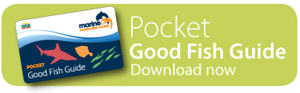
Carry an MCS pocket guide with you to remind you of these ratings while you're out and about, or use it for writing your shopping list. This handy guide lists the best choices you can make when buying seafood.
Tell your family and friends all about the importance of choosing sustainable seafood and point them in the direction of the MCS website to find out more!
5. Variety is the spice of life
This is especially true when it comes to eating seafood. As consumers we are too reliant on the “Big 5” (Cod, Haddock, Tuna, Salmon and Prawns). One of the easiest ways to buy sustainable seafood is to choose alternative species that have not been overfished. Choose Pollack or Gurnard instead of cod, or why not try MSC certified mackerel instead of tuna.
6. Choose fish caught using methods with lower environmental impact such as hand-lining or potting.
When buying tuna, for example, try to buy line caught (pole & line or hand-line) or troll caught, dolphin-friendly fish.
For more information on the relative sustainability of fishing gears, see the MCS Gear League Table.
7. Look at labelling information to help you choose sustainable seafood
Retailers are required by EU law to state the species of fish, production method (wild caught/farmed), and capture area. Many retailers now provide more information, including capture method. If the labelling information is insufficient for you to make an informed choice, ask the fishmonger/waiter for more information, specifically where the fish is caught and how. If a generic term is used for name of fish e.g. "skate" or "tuna" ask what species it is.
8. Look for the Marine Stewardship Council (MSC) logo.
Seafood displaying this mark can be found in the frozen and fresh counter sections of your retailer, and are becoming increasingly popular in restaurants. They are certified as coming from sustainably managed stocks.
9. Choose Organic, when buying farmed seafood (Salmon, Trout, Tiger/King Prawns etc).
Organically farmed seafood comes from farms with lower stocking densities, high standards of environmental performance and are fed with feed sourced in a sustainable manner.
10. Avoid eating deepwater fish and sharks.
Deepwater species include orange roughy, blue ling, redfish, and dogfish (also called huss or rock salmon) and nursehound, which are species of shark. These tend to be slow-growing, long-lived species which breed slowly. These are all characteristics that make deepwater species and sharks vulnerable to over-exploitation. In addition, fishing for deepwater species can harm fragile species in the deep-sea (such as cold water coral reefs) that may never recover.


Company Limited by Guarantee No. 2550966
Registered Charity England and Wales No. 1004005 |
Scotland No. SC037480
Registered Office: Unit 3, Wolf Business Park, Alton Road,
Ross on Wye HR9 5NB, Scottish office: 3 Coates Place,
Edinburgh EH3 7AA. Copyright MCS 2012 All rights reserved.