
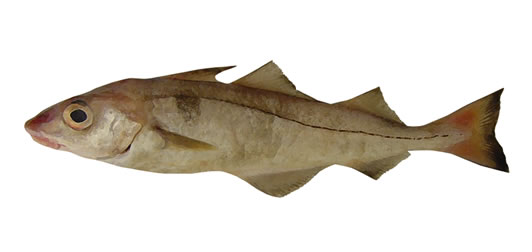
- Common name - Haddock
- Scientific name - Melanogrammus aeglefinus
- Visit Fishonline for the full range of options available for this species.
- Consumer Information
- Haddock is a cold-water species, related to, but smaller than cod. Haddock is really popular whether it's fresh, frozen, smoked or served with chips. Easily identified by a black lateral line running along its side and a dark blotch above the pectoral (side) fin, often referred to as ??St Peter's thumbprint'. Smoked haddock is really popular, traditionally produced for generations in the smoke houses of Grimsby and Arbroath (Arbroath ??smokies'). It's a great source of protein and is low in fat. Avoid eating immature fish, below 30 cm, and during their breeding season, February to June. Choose line-caught fish where available. MSC-certified options for this species are now available.
- Summary
- Haddock from the northeast Arctic (Barents and Norwegian Seas) and in the combined stock areas of the North Sea, Kattegat and Skagerrak, are at healthy or sustainable levels and being fished sustainably. Haddock, however, occur in mixed fisheries with other fish such as cod, which are depleted in some areas, in particular the North Sea, Irish Sea and waters west of Scotland. Part of the Norwegian fishery for haddock in the northeast Arctic, and part of the Scottish North Sea Haddock fishery is certified as sustainable by the Marine Stewardship Council and offer the best options for haddock. To help reduce the impact of fishing on fish stocks, where fishing effort is too high, the marine environment, and species, choose line-caught fish where available. When buying longline-caught haddock, ask for fish caught using 'seabird-friendly' methods. See Fishing Methods for details.
- Alternatives
- (Based on method of production, fish type, and consumer rating: only fish rated 3 and below are included.)
- Visit Fishonline, the website for the seafood industry, for more detailed information about this species.


Marine Conservation Society
Company Limited by Guarantee No. 2550966
Registered Charity England and Wales No. 1004005 |
Scotland No. SC037480
Registered Office: Unit 3, Wolf Business Park, Alton Road,
Ross on Wye HR9 5NB, Scottish office: 3 Coates Place,
Edinburgh EH3 7AA. Copyright MCS 2012 All rights reserved.
Company Limited by Guarantee No. 2550966
Registered Charity England and Wales No. 1004005 |
Scotland No. SC037480
Registered Office: Unit 3, Wolf Business Park, Alton Road,
Ross on Wye HR9 5NB, Scottish office: 3 Coates Place,
Edinburgh EH3 7AA. Copyright MCS 2012 All rights reserved.